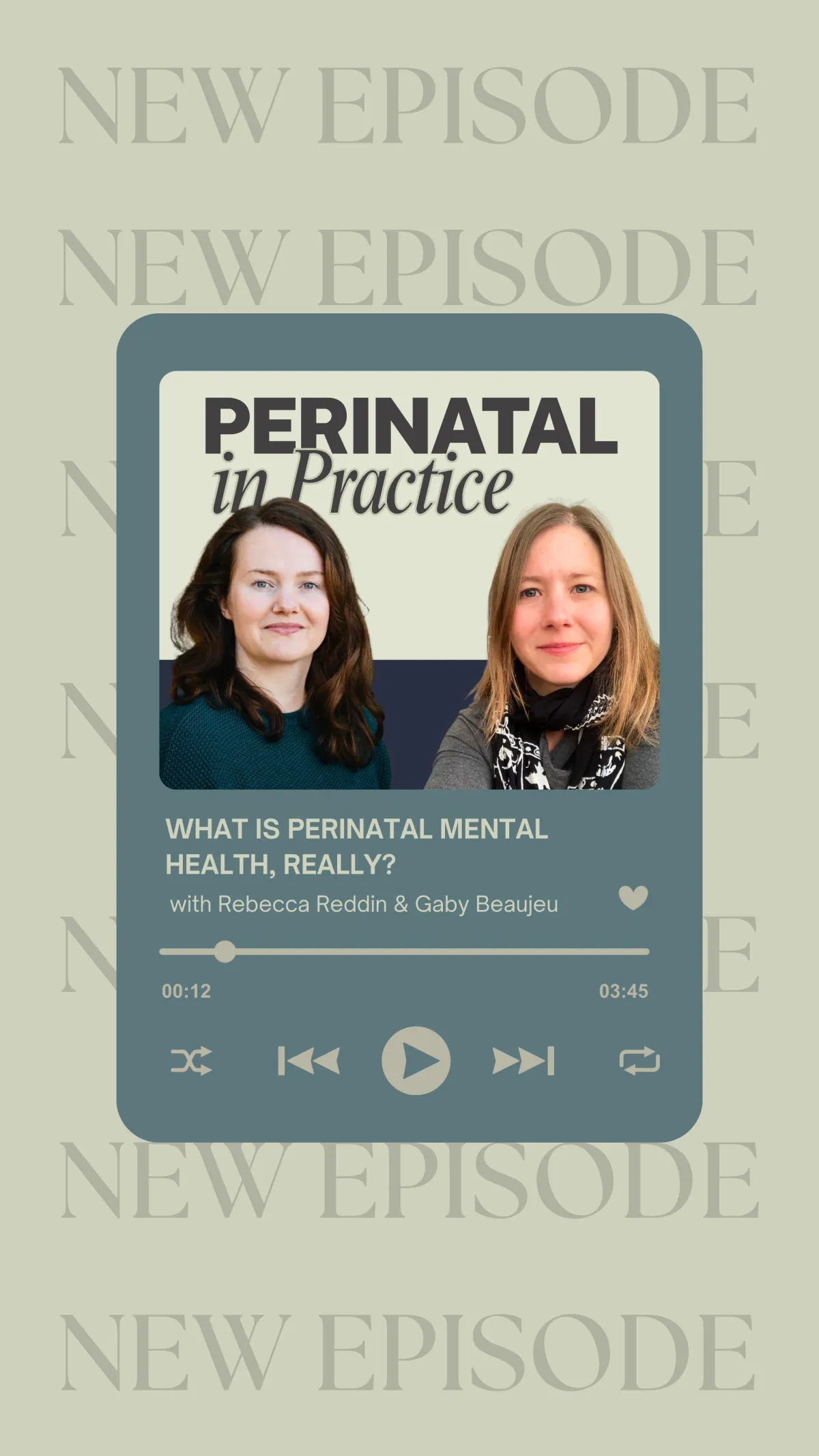
What is Perinatal Mental Health Really?
What is Perinatal Mental Health Really? With Gaby Beaujeu
Welcome to our first conversation episode!
We've been hearing so much more about perinatal mental health lately, which is fantastic. But it raises a really important question: are we all talking about the same thing? And does perinatal mental health actually need to be an area of specialty, or is our general mental health training enough?
That's exactly what we unpacked in our first interview episode ofPerinatal in Practice, and I was delighted to be joined by our very own Gaby Beaujeu, who really knows this territory well.
Gaby is a perinatal psychotherapist at Mindful Roots Counselling and our community coordinator at the Perinatal Mental Health Institute, where she also supports our clinical trainings. She started out in child and family services as a licensed clinical social worker, cut her teeth in an early intervention programme for first-episode psychosis, and later completed her PSI certification and Gottman training in couples therapy. Today she works exclusively with the perinatal population, with individuals and with couples.
My hope is that by the end of this post, you'll feel a little more confident about what we mean when we say perinatal mental health, what it means to specialise, and what the next step might be for you.
Perinatal Mental Health is a much wider umbrella than we think
Gaby loves breaking words down, so she started there. Peri means around, natal means birth: mental health around birth. But if you stop there, you miss how wide the umbrella really is.
Yes, we picture the postpartum mum, potentially one to two years after baby arrives. But perinatal mental health also covers the whole journey to get to pregnancy, the journey through pregnancy to birth, and beyond. And even once that window has passed, the door doesn't close. Sometimes people need to come back and process it all later.
So often we think of the postpartum period as the six weeks after baby arrives, or, if we look at the DSM, just the four weeks after. That's a tiny window, and it leaves out fertility, conception, pregnancy, postpartum and parenting. My question is always: when does matrescence actually end?
Why separate it from general mental health?
This is where the "perinatal" in perinatal mood and anxiety disorders (PMADs) really matters. As Gaby put it, the flavour of these illnesses in this period is very distinct. From the most common to the most rare, there are specific components that are easy to miss if you don't know what you're looking for.
Take intrusive thoughts. Garden variety generalised anxiety looks very different from the specific intrusive thoughts that can show up postpartum. If you're not sure what you're listening for, it's easy to get it wrong.
And think about the layers. Anxiety at 3am with a screaming baby, no sleep, hormones all over the place, and the sense that you don't even know who you are anymore because everyone expects you to show up in a totally new way. That isn't the same picture as anxiety outside the perinatal period.
Gaby also named something I see constantly: how few eyes are on mum in this time. In those first six weeks, she often hasn't even had her six-week check yet. A lot can go sideways quickly, and "let's wait and see" isn't always safe. Time is of the essence. Wouldn't it be lovely if we had more eyes on mum, and on both the birthing and non-birthing partner, rather than assuming that a healthy baby means everything is fine?
You don't know what you don't know
I'll be honest: when I started my career, I didn't think we needed specialisation. I assumed everything from my general mental health training would apply. The more I learned, the bigger an advocate I became. When I did my perinatal training, I had so many heart-sink moments looking back on previous clients. "Oh, I missed that. Oh, I said the unhelpful thing." All we can do is our best, but I didn't know what I didn't know.
So what tends to get missed? For Gaby, it comes down to the quality of our questions, and how comfortable we are broaching extremely uncomfortable topics like suicidality. It's an easy mistake to lead the witness: "You're not having suicidal thoughts, are you?" Specialised training builds the confidence to ask the hard questions at the right time, in the right way, and to reach for the right screening tools rather than a generic anxiety screener.
Without that, as Gaby said, it's a bit of a lottery depending on who happens to be sitting in front of you. In the most extreme cases the consequences can be catastrophic. In everyday cases, we can unintentionally make things harder with lines like "At least you have a healthy baby" or "You should be so happy, this is what you always wanted." They don't come from a bad place. They come from a lack of awareness of how painful they are, and how unseen they can leave a parent feeling.
Never underestimate the courage it took
One thing Gaby said really struck me: never underestimate how much bravery it took for a mum to tell anybody what's really going on. She probably still hasn't told you how bad it really is, because of stigma, shame, or not knowing who to go to. And she may be wondering whether she even has time for an hour of therapy a week.
So many new parents walk in saying, "I'm broken. There's something wrong with me. I'm a terrible mother." A specialist knows that what they need to hear is the opposite: coming in is wise, proactive and brave. You are doing the right thing by you, by your baby, and by your family by saying, "This is a lot harder than I thought it would be."
Gaby's why
Gaby shared, so generously, that she came by this work honestly. After her son was born, she experienced postpartum psychosis.
With that condition, care comes quickly and with a large team, and you're crossing your fingers that they know what they're doing. Gaby had a team that absolutely did. Her perinatal psychiatrist asked the hard questions about medication and breastfeeding, and spoke to fears she didn't feel able to say out loud. The social worker who ran her mother and baby programme met her with calm competence and gently refuted every belief that she was bad, broken or wrong. This is temporary. This is not a moral failing or a character flaw.
She could tell who knew what they were talking about and who was phoning it in. Experiencing incredible care is what lit the fire in her belly to become that person for other families.
As she was speaking, I kept thinking: what a different trajectory it could have been if her care team hadn't been specialised. No matter which PMAD, clunky transition or stage of matrescence someone is navigating, the outcome is so different when the people supporting them have the training.
Specialised care is not siloed care
Whether we work one-to-one with clients or as part of a hospital, clinic or wider system, none of us should be doing this work alone. We need community, both for our own support and so our clients can access everything they need.
Gaby added a piece I love here. Our clients often don't know what questions to ask. Do they know they can sign a release so you can speak to their prescriber? That their partner can join a session for an advocacy conversation? We can't assume they have the knowledge we have. Filling in those gaps is part of our role, and it's a uniquely perinatal piece of the work.
What good perinatal-informed care looks like
For Gaby, it comes back to one phrase: mother first, and always. Good care is:
Centred on her, and realistic about what she can and can't manage right now
Done with her participation, not to her
Rich in education and choice, so she has as much control as possible
Tailored to the person in front of us, recognising that her wishes may not be the ones we'd choose
Getting this right doesn't just feel better. It saves so much unnecessary suffering and trauma down the road, and it tells her that we are truly listening.
Two myths worth breaking
Myth 1: Perinatal support has an expiry date.Six weeks, one year, two years, and then the door closes. Not true. You can have grown children and still need specialised support to process a traumatic birth, an infant loss, or a difficult fertility journey. It is never too late to be held and to make meaning from it.
And it works the other way too. You don't need to be holding a baby to be eligible for support. Couples thinking about starting a family, or someone who suspects fertility treatment may be on the horizon, can reach out at any stage of matrescence.
Myth 2: Supporting mum is the whole job.When a mum is unwell, it's easy to pour all our attention into her and forget the partner. There are even tropes and jokes about it. But if she's on a PMAD journey, her partner is on it too. They may not be driving the car, but they're in the co-pilot seat, or at least the back seat, and they're scared as well.
Gaby shared that her social worker checked in with her husband every week or two. Years later, he told her that clinician was the first one who ever told him how she was doing, the first one who cared to wrap him in. When mum is just trying to keep her head above water, let the partner have someone to bring their worry to.
Nobody starts as a specialist
We've talked a lot about why specialisation matters, so I want to be really clear: nobody starts as a specialist. Everybody starts at the beginning.
When I asked Gaby what one thing she'd want someone at the start of their journey to take away, her answer was simple:you belong here.
Stay curious. It's so easy to fall into the assumption that "I had a baby, so I know" or "I had my own postpartum experience, so I know." Whether or not you have lived experience, if any part of this sparks your interest, lean in. There are incredible resources and spaces to keep learning. As Gaby put it, we want these tables long. Pull up a seat.
Your next step
We mentioned PMADs a lot in this conversation, but there wasn't time to dive into each one. If you'd like to start there, we have a free 30-minute training that gives a brief overview of all the perinatal mood and anxiety disorders. You'll find the link in the show notes.
You can listen to the full conversation with Gaby on Perinatal in Practice, available on Apple Podcasts, Spotify and YouTube. If you find it useful, subscribe so you don't miss the next piece of the puzzle, and share it with someone else who's part of someone's village. And if you want to go deeper, that's exactly what we do at PMHI.
Until next time, take good care of you. You can't pour from an empty cup, and your village needs you well.